Our Policy Action Plan
2022-2025
We are dedicated to promoting policies that align with our goals of breaking down the barriers to economic mobility for our community.
We educate and advocate for a more impactful workforce system where everyone has access to family sustaining wages and quality jobs
3 Action Areas

Build more on ramps to in demand careers and improve job quality particularly at the front line/essential job categories
Action →
Action:
Promote investment in high-quality skills training and strengthened career navigation supports; and incentivize employers to support internal pathways to advancement

Create more employment opportunities for individuals with criminal justice experience
Action →
Action:
Decrease the number of barriers that hinder individuals with previous involvement with the criminal justice system to obtain employment with livable wages and career paths.

Acknowledge and address the social determinants of work
Action →
Action:
Advocate for better integration of more holistic supports into workforce programming to increase engagement, retention, and advancement in the workforce, leveraging TE alumni voice in storytelling.
What Drives Us
Social Determinants of Work
Towards Employment works with partners to provide individualized access to supportive services and other resources to Cuyahoga residents. Together, we work to address barriers of the social determinants of work.
Social Determinants of Work
WorkAdvance:
Our Career Pathway Model
Worker-Focused
Right job at the right time at the right place with seamless and comprehensive supports in place.
Employer-Focused
Deep understanding of employer needs that is responsive to hiring needs.
Advancement-Focused
From the beginning of engagement, an employment plan focused on growing a career, not just a job.

Connect job seekers to high demand sectors that offer quality jobs with strong career pathways.
The program's model takes a dual customer approach to meet the needs of both job seekers and employers.
Policy Work
We work with community members and policy partners to track and support legislation by collecting testimony, meeting with elected officials and collaborating with organizations on city, county, state, and nationwide initiatives.
Advocates Applaud Legislature and Governor DeWine for Reducing Debt-Related Driver’s License Suspensions with Passage of HB 29
Published January 8, 2025 Read the full press release at ACLU’s website Today, Governor Mike DeWine signed House Bill 29, legislation that will remove many of the financial barriers that lead to driver’s license suspensions. With the adoption of this policy, Ohio becomes the 25th state to move away from debt-related penalties. In Ohio,…
Real-Time Takes: Collateral Sanctions and Banking- Gwen Awoyade
This is a story of Gwen, a courageous woman who overcame the stigma and barriers faced by every justice involved person. She applies her experience with restoring her own access to banking by helping Towards Employment participants rebuild their finances.
Cleveland VOTES wants Northeast Ohioans to get time off to vote in the 2024 election
By Greory Burnett Published October 28, 2024 Read the full article at The Land Cleveland VOTES has held numerous events this year to get people registered for the 2024 election. Now, they’re trying to ensure Clevelanders have time off to cast a ballot. [Photo courtesy of Erika Anthony] Donté Gibbs believes there’s a lot at…
Your Story Can Effect Change
We work with community members and policy partners to track and support legislation that reinforces our mission and ensures all Greater Clevelanders have a chance to thrive. We meet with elected officials and collaborate with organizations on city, county, state, and nation-wide initiatives.
A critical component of our advocacy work is testimony from individuals who have been affected by policies, or a lack thereof. These stories reinforce the need for policy changes and can have a real and lasting impact on people across our region, state and country.
Seeking Stories on Driver’s License Suspensions
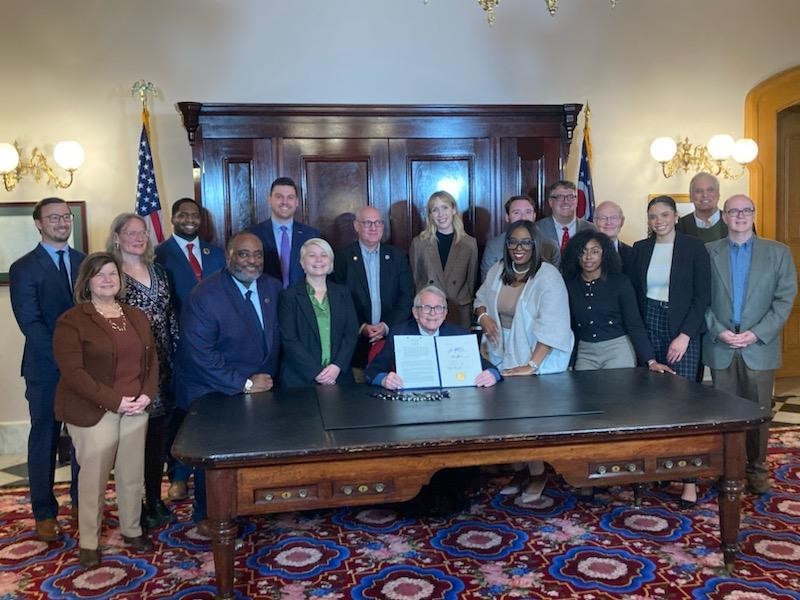
In January 2025, Governor Mike DeWine signed House Bill 29, legislation that will remove many of the financial barriers that lead to driver’s license suspensions. This is a big win for our state and its residents. With the adoption of this policy, Ohio becomes the 25th state to move away from debt-related penalties. Stories from those affected by debt-related suspensions played a big role in getting this legislation passed.
Now, our attention must turn toward ensuring the legislation is implemented effectively. We are continuing to collect stories from those affected by fee-related driver’s license suspensions to keep the spotlight on this issue and guarantee hundreds of thousands of Ohioans get their licenses back.
Share Your Story!
If you’d like to contribute to our advocacy work, please use the prompts at right to share your experience and a member of our team will follow up to receive more details. Your story may be shared through a variety of channels, including newsletters, social media, our website, legislative testimony, and more. We will never use your story without your explicit permission. You will be guided through a consent process following submission of your story.
Real-Time Takes
Real-Time Takes is a Towards Employment "Blogcast" highlighting real people, often TE alumni, and their personal stories on challenges, and triumphs happening in "real-time". Explore their stories in 1 on 1 interviews shared as digital multi-media articles including their own authentic audio or video.
Check out our most recent Real-Time Takes blogcast:

Real-Time Takes: Housing
Access to housing is a key factor to economic mobility. Without a place to live, the wellbeing and safety of thousands of Clevelanders is compromised. Towards Employment sat down with Austin Cummings, Senior Researcher at the Fair Housing Center for Rights & Research shed light on housing injustices within Cuyahoga County.
Real-Time Takes: Collateral Sanctions and Banking- Gwen Awoyade
This is a story of Gwen, a courageous woman who overcame the stigma and barriers faced by every justice involved person. She applies her experience with restoring her own access to banking by helping Towards Employment participants rebuild their finances.

Real-Time Takes: GROW Act – Collateral Sanctions: Record Sealing
For nearly a decade, Jane Doe made “bad decisions, with bad people, in bad places”. She was convicted with a total of three fifth (5th) degree felony charges for Drug Possession and one third (3rd) degree felony for Failure to Comply. Her offenses spanned three different counties: Cuyahoga (2015), Lake (2017) and Richland (2018). Jane Doe completed each of her sentences: nine months in prison and multiple years of community control sanction; along with a suspended driver’s license and the various fees and fines associated with her cases.

Real-Time Takes: STARs – Success Stories Despite the Odds
Did you know that if you are at least 25, have a high-school diploma but not a four-year degree, and are currently active in the workforce, you are a STAR (Skilled Through Alternative Routes)?
Although over 50% of the workforce are STARs (more than 70 million people), the job market deliberately prioritizes and rewards those with degrees.1 Opportunity@Work, in partnership with the Ad Council, launched ‘Tear the Paper Ceiling’, a campaign dedicated to advancing opportunities for STARs. Their research finds that while 67% of job descriptions require a four-year degree, only 30% of positions truly need a degree.2 Despite the need for qualified workers, employers continue to prefer and demand candidates with four-year degrees over STARs with relevant experience and knowledge.

Real-Time Takes: Second Sentence
A recent New York Times article delved into a devastating fact: over 60 percent of those leaving prison in the United States are unemployed a year later. While prejudice against returning citizens is hardly a thing of the past, recent polling suggests that the majority of Americans believe that people who have been convicted of crimes deserve a second chance.1
A major reason for the disconnect between the facts on the ground and public opinion is something that experts who work with reentering citizens call “collateral consequences.” These are the legally imposed barriers that those who have served their time face, hurdles that I have come to view as a second sentence.

Real-Time Takes: Job Quality
When I ask my kids if they like their job, the first thing they mention is how much it pays – or does not pay. But whatever the pay scale and fringe benefits, the conversation soon turns to the quality of their job.
It turns out that most Americans agree that the quality of their job has a strong impact on their quality life.1
Covid put pressure on everybody at work and 40 percent of Americans working in 2020 experienced a decline in the quality of their jobs.2
Advocacy Initatives & Coalitions

Initiative Spotlight
Drive to Justice & SB37: Decriminalize Poverty
Drive to Justice is a coalition of community-based organizations (Neighborhood Connections, Policy Matters, Building Freedom Ohio, and Towards Employment) advocating to end debt-related driver’s license suspensions in Ohio. By providing education and support while connecting with policymakers, Drive to Justice aims to mobilize and empower community members around the issue of debt-related driver’s license suspensions, ensuring that public policy is informed by the views of Ohioans most affected by these policies.
Initiatives
Senate Bill 37 removes the ability to suspend a person’s license for non-driving related issues, such as unpaid parking tickets, therefore removing the barrier to employment for millions of hard-working Ohioans and businesses that employ them.
Ohio sees roughly 3 million license suspensions per year with over 60% of these being for debt-related reasons, such as a missed traffic ticket. Individuals struggling to get to work and pay bills may find themselves trapped in a financial crisis that is difficult to overcome once they miss a court payment. Driver’s license suspension places individuals in a difficult position wherein they must choose between missing work, losing access to health care, childcare, food, and other necessities, or driving on a suspended license, which can spiral into involvement with the criminal justice system.
Employers in Ohio are all struggling to find employees to fill in demand jobs. Senate Bill 37 will help employers retain good employees by allowing them to continue to drive to work.
Suspending a person’s license for a non-safety, non-driving related reason harms Ohio’s economy and our businesses by keeping people from getting to work. This doesn’t need to be the case.
Senate Bill 37 would dramatically improve the landscape for millions of Ohioans by removing license suspension as an enforcement mechanism for unpaid traffic tickets. There are other means for courts and third parties to have their debts resolved including collection agencies, wage garnishment, and seizing federal tax refunds.
The ability of Ohio's workforce to commute to their workplaces is paramount, as it directly influences the economic productivity and vitality of our state. We urge your support for this bill.
Over 1 million Ohioans with criminal records are eligible to have their records sealed: What are we waiting for?
Published July 2024 in Policy Pulse, A Towards Employment Newsletter
Article written by guest author Patrick Higgins
The Getting Rehabilitated Ohioans Working (“GROW”) Act, House Bill 460, is a legislative solution to an issue that is widespread throughout Ohio: the pervasiveness of criminal records long after a person has served whatever penalty was imposed for their conviction. We call the lasting impacts of contact with the criminal legal system collateral sanctions. Collateral sanctions are not part of a person’s sentence but show up among the hundreds of restrictions on things like employment or in less formal ways like stigma. This may include restrictions on everything from occupational licensing to a person’s ability to chaperone a child’s field trip. Collateral sanctions span far and wide and they generally do not go away until a person seals their record. When a criminal record is sealed, a person may treat it as though it no longer exists, and it becomes inaccessible to most members of the public.
The GROW Act makes the record sealing process less difficult by making it semi-automatic. While it would not change record sealing eligibility, the bill does take the burden off the person who wants to have their record sealed. This is an important step because the record sealing process is more burdensome than many realize. Consider the following likely steps for a record sealing applicant (which are done with or without the help of an attorney): 1) Determine that they want to have a record sealed; 2) Determine whether or not they are eligible for record sealing (only after the person has met eligibility criteria such as paying outstanding fines and restitution); 3) Fill out a record sealing petition; 4) File the petition(s) by paying a filing fee or by asking the court to waive the filing; 5) Prepare for a record sealing hearing (with or without the help of an attorney); 6) Take time off for a record sealing hearing (keep in mind that, if the petitioner is an hourly worker, that this time is likely unpaid); 7) Secure and pay for childcare (if applicable) for the date of a record sealing hearing; and 8) Attend the record sealing hearing and advocate for record sealing.
Instead, the GROW Act tasks Ohio’s Bureau of Criminal Investigation with compiling a list of sealing-eligible records and forwarding it to courts and their prosecutors. Under the as-introduced version of the GROW Act, prosecutors then have 90 days to review the record and object to the sealing of the record. If there is no objection, the court would then proceed with sealing the criminal record. Further, following the sealing of a criminal record, an employer is provided with immunity from negligence claims related to an employee’s sealed records.
Over one million Ohioans stand to have their records sealed by the GROW Act. This is why we see a broad range of organizations and individuals supporting the bill and its potential impact on applicants and employers alike. The bill currently sits in the House Criminal Justice Committee and needs to pass the House and Senate before being signed by the Governor to become law.

Patrick Higgins (guest writer) serves as policy counsel for the ACLU of Ohio. In this role, he combines his legal training and love for good policy to advocate for impactful changes at the state and local levels. Patrick primarily works on issues related to the ACLU Campaign for Smart Justice which is a multiyear effort to reduce the U.S. jail and prison population and combat racial disparities in the criminal legal system.
Community Collaborations
Drive to Justice is a coalition of community-based organizations (Neighborhood Connections, Policy Matters, Building Freedom Ohio, and Towards Employment) advocating to end debt-related driver’s license suspensions in Ohio. By providing education and support while connecting with policymakers, Drive to Justice aims to mobilize and empower community members around the issue of debt-related driver’s license suspensions, ensuring that public policy is informed by the views of Ohioans most affected by these policies.
Currently, a driver’s license can be suspended due to the inability to pay for child support or court fees and fines, the failure to attend traffic court and even missing insurance payments. Approximately 60% of Ohio driver’s license suspensions are debt-related, with these suspensions disproportionately impacting impoverished communities. 82% of Ohioans drive themselves to work, with only 1.4% relying on public transportation. How can someone earn the money to pay for child support or a court fee if they can’t get to work?
Generation Work
Towards Employment is a Generation Work partner helping connect and train young adults for great careers.
Generation Work is a partnership launched by the Annie E. Casey Foundation to help young Americans succeed in the job market. This partnership is designed for ages 18-24 who are enrolled in federal workforce programs and eligible for public benefits.
Aspen Institute Northeast Ohio Workforce Coalition
The Ohio Workforce Coalition, with NEOWC as local partner, was selected in a nationally competitive process to facilitate the Aspen Institute Workforce Leadership Academy (WLA) in Cleveland. The Workforce Leadership Academy, with curriculum designed by the Economic Opportunities Program of the Aspen Institute, brings together leaders from across a local workforce ecosystem for a year-long series of retreats, workshops, and action learning projects. The Academy provides a forum for local leaders to work collaboratively to identify local and regional systems-based challenges and create shared solutions for economic opportunity for all. Fellows work with leading practitioners throughout the country as they deepen networks; strengthen systems leadership skills; apply race, equity, and systems change frameworks to their work; and increase understanding of effective strategies and programs.

Northeast Ohio Workforce Coalition
Northeast Ohio Workforce Coalition (NEOWC) is an affiliate of the Ohio Workforce Coalition and shares the vision of a future where Ohioan’s have equitable access to opportunity and the supports they need to take advantage of it; Ohio’s businesses have a skilled workforce advancing in quality jobs; and Ohio’s workforce systems are aligned, transparent, and accountable.
Voter Engagement
Towards Employment believes a person's vote is their voice in their community. We advocate for every eligible person to become a registered voter and exercise their democratic right to vote in every election.
We do this by partnering with local and national organizations to share voting resources and voting requirement updates to those at Towards Employment and across our local community.
Thank you to our Partners in Democracy:


Partners in Policy &
Systems Change





Contact Us
Get in touch with Towards Employment's policy team at policy@towardsemployment.org or contact an individual staff member below.